

PRODUCTS
CONTACT US
TEL: +86-532-85754589,85775618
FAX: E-Mail
E-MAIL: tlead.net@gmail.com; tlead.net@hotmail.com

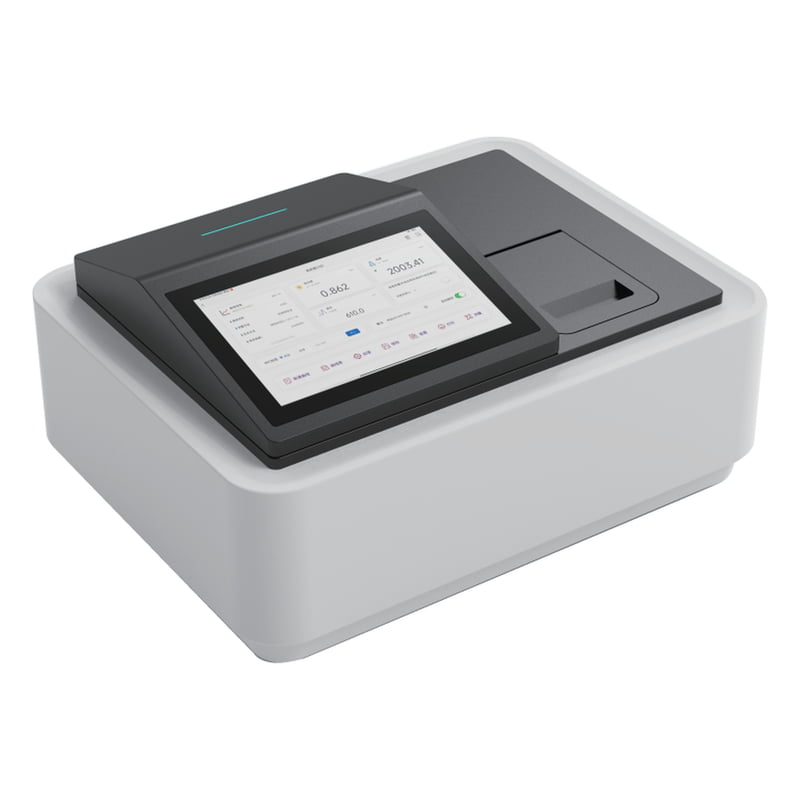
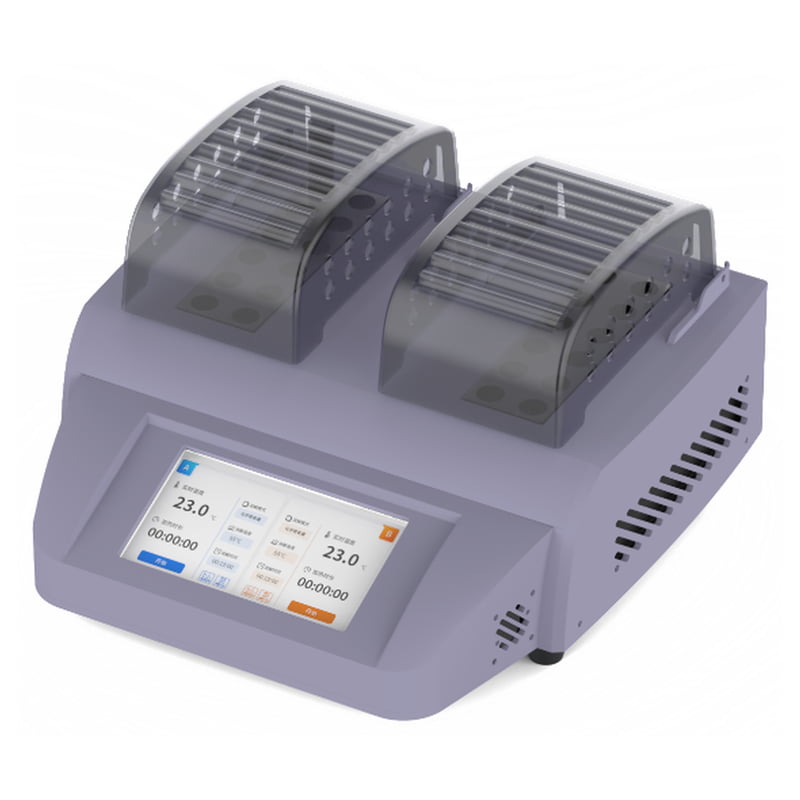
With AMT5001J Dual-Zone Digestion Unit Included
Keywords: water quality analyzer, water quality spectrophotometer, UV-Vis spectrophotometer for water testing, COD analyzer, water digestion system

1. Combines water quality analysis with UV-Vis spectrophotometry, reducing the need for separate instruments.
2. Supports up to 52 water quality test modules, including COD, ammonia nitrogen, total phosphorus, total nitrogen, turbidity, color, and selected metals and nonmetals. More than 200 standard curves are available.
3. NFC method recognition can identify a tagged test tube, call up the corresponding method and calibration curve, and save the result automatically.
4. A ratio double-beam optical system covers 190 to 1,100 nm, with a 2 nm spectral bandwidth.
5. Built-in audit trail, user roles, and power-loss protection support organized data handling and review.
6. Wi-Fi printing and Excel or PDF data export are supported. App, mini-program, and cloud connectivity are also described in the source specifications.
7. The included AMT5001J digestion unit has two independently controlled heating zones and capacity for 24 tubes.
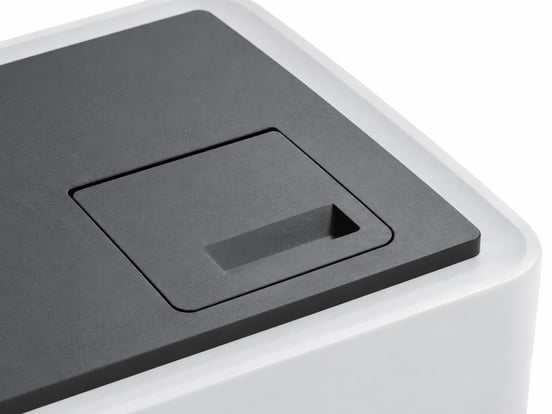
Sample compartment cover | 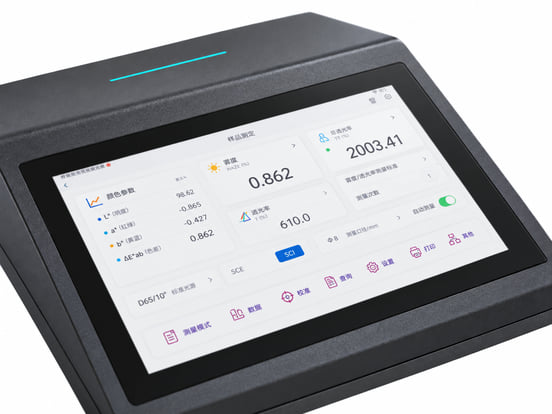
Touchscreen display | 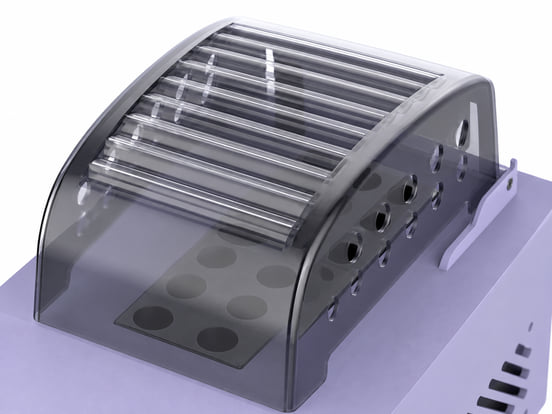
Transparent protective cover |
| Parameter | Specification |
|---|---|
| Optical system | Ratio double beam |
| Wavelength range | 190–1,100 nm |
| Spectral bandwidth | 2 nm |
| Wavelength accuracy | ±0.1 nm at 656.1 nm; ±0.3 nm across the full range |
| Photometric range | −0.3 to 3 A; 0–9,999 C; 0–9,999 F |
| Transmittance accuracy | ±0.3% (0–100%); ±0.002 A (0–0.5 A); ±0.003 A (0.5–1 A) |
| Transmittance repeatability | 0.15%T (0–100%T); ±0.001 A (0–0.5 A); ±0.0015 A (0.5–1 A) |
| Baseline flatness | ±0.0015 A |
| Stray light | 0.03%T at 220 nm and 360 nm |
| Noise | ±0.0002 A at 500 nm after warm-up |
| Light sources | Deuterium lamp and tungsten lamp |
| Detector | Silicon photodiode |
| Photometric modes | Transmittance, absorbance, concentration, and energy |
| Measurement functions | Photometric measurement, quantitative analysis, wavelength scanning, multi-wavelength measurement, kinetics, and DNA/protein measurement |
| Water test modules | Up to 52 water quality test modules; test availability depends on the selected method |
| Water test indication error | ≤ ±8% |
| Water test repeatability | ≤ ±3% |
| Water test resolution | Absorbance: 0.001 / 0.0001 / 0.00001 A; standard concentration: 0.01 mg/L, with 0.001 / 0.0001 / 0.00001 mg/L options |
| Optical stability | ≤ ±0.001 ABS over 20 minutes |
| Colorimetric modes | Tube and cuvette channels; supports 10, 20, 30, and 50 mm cuvettes |
| Connectivity and data | Instrument connection, data output, printing; Excel and PDF export |
| Printing | Wi-Fi printing |
| NFC method recognition | Supported |
| Audit trail | Supported |
| Data storage | No limit stated in source specifications |
| Parameter | Specification |
|---|---|
| Model | AMT5001J |
| Heating zones and capacity | Two independently controlled zones; 24 tubes total |
| Sample volume | 0–10 mL |
| Temperature range | 45–200 °C; user adjustable |
| Heating rate | Reaches a set temperature of 165 °C within 10 minutes |
| Temperature indication error | ≤ ±2% |
| Timer range | 1 minute to 99 hours |
| Custom programs | 5 user-defined programs |
| Stored digestion programs | COD, total nitrogen, total phosphorus, arsenic, total chromium, plus one additional preset program (six preset programs stated in source) |
| Display | 7-inch color capacitive touchscreen |
| Dual-zone operation | Supported |
| Quick mode switching | Supported |
| Delay protection | Supported |
| Smart heating | Supported |
| Clock display | Real-time clock |
| Timer and alerts | Timer; heating-complete alert; over-temperature alert |
| Overheat protection | Supported |
| Digestion log and temperature curve | Supported |
| Safety features | Transparent high-transmittance safety shield and protective panel |
| Rated power | 900 W |
| Rated voltage | AC 220 V, 50 Hz |
| Dimensions | 340 × 240 × 214 mm |
| Weight | 6.0 kg |
| Parameter | Measurement range | Method |
|---|---|---|
| Chemical oxygen demand (COD) | 5–100 / 100–10,000 mg/L (segmented) | Rapid digestion spectrophotometry |
| Ammonia nitrogen | 0.05–30 mg/L (segmented) | Nessler reagent spectrophotometry |
| Ammonia nitrogen | 0.5–50 mg/L (segmented) | Salicylic acid photometry |
| Total phosphorus | 0.01–15 mg/L (segmented) | Molybdate spectrophotometry |
| Total phosphorus | 0.5–100 mg/L (segmented) | Ammonium vanadomolybdate colorimetry |
| Suspended solids | 5–100 / 100–700 mg/L | Kaolin colorimetry |
| Total nitrogen | 0–10 mg/L | Alkaline potassium persulfate digestion and UV spectrophotometry |
| Total nitrogen | 0.5–30 mg/L | Chromotropic acid spectrophotometry |
| Free chlorine | 0–15 mg/L (segmented) | DPD spectrophotometry |
| Total chlorine | 0.05–3 mg/L | — |
| Chlorine dioxide | 0.02–3 mg/L | — |
| Formaldehyde in air | 0.01–1.5 mg/m³ | Acetylacetone spectrophotometry |
| Formaldehyde in water | 0.5–10 mg/L | Chromotropic acid spectrophotometry |
| Formaldehyde in textiles | 0.1–50 mg/L | Phenol reagent spectrophotometry |
| Turbidity, cuvette | 0.5–10 / 10–100 / 100–1,000 NTU | Formazin turbidimetry |
| Turbidity, test tube | 5–100 / 100–800 NTU | Formazin turbidimetry |
| Color | 0–10 / 10–100 / 100–500 PCU | Platinum-cobalt colorimetry |
| Hexavalent chromium | 0.01–10.0 mg/L (segmented) | Diphenylcarbazide spectrophotometry |
| Total chromium | 0.01–10.0 mg/L (segmented) | Potassium periodate oxidation and diphenylcarbazide spectrophotometry |
| Nitrite | 0.01–0.2 mg/L | N-(1-naphthyl)ethylenediamine hydrochloride photometry |
| Nitrite nitrogen | 0.01–0.2 mg/L | N-(1-naphthyl)ethylenediamine hydrochloride photometry |
| Nitrate nitrogen | 0.5–10.00 mg/L | Phenoldisulfonic acid photometry |
| Nitrate (as nitrate ion) | 0.5–20.00 mg/L | Phenoldisulfonic acid photometry |
| Permanganate index (oxygen consumption) | 0.2–5.0 mg/L | Potassium permanganate oxidation spectrophotometry |
| Sulfate | 5–100 mg/L | Barium chromate spectrophotometry |
| Phosphate | 0.01–50 mg/L (segmented) | Molybdate spectrophotometry |
| Phosphate | 0.5–50 mg/L | Ammonium vanadomolybdate colorimetry |
| Iron | 0.05–3.00 mg/L | 1,10-Phenanthroline spectrophotometry |
| Trace iron | 5–200 µg/L | Ferrozine photometry |
| Silver | 0.01–1 mg/L | 3,5-Br₂-PADAP spectrophotometry |
| Copper | 0.05–3.00 mg/L | Sodium diethyldithiocarbamate spectrophotometry |
| Lead | 0.05–4.00 mg/L | Xylenol orange spectrophotometry |
| Cyanide | 0.01–1.0 mg/L | Isonicotinic acid–barbituric acid spectrophotometry |
| Arsenic | 0.05–3.00 mg/L | Arsenic-antimony-molybdenum blue photometry |
| Aluminum | 0.03–0.4 mg/L | Chrome azurol photometry |
| Zinc | 0.05–2.0 mg/L | Zincon spectrophotometry |
| Manganese | 0.05–5.00 mg/L | Potassium periodate spectrophotometry |
| Cadmium | 0.05–3.00 mg/L | Cadmium reagent spectrophotometry |
| Trace cadmium | 2.5–50 µg/L | 5-Br-PADAP spectrophotometry |
| Nickel | 0.05–3.00 mg/L | Dimethylglyoxime spectrophotometry |
| Sulfide | 0.01–1.0 mg/L | Methylene blue spectrophotometry |
| Chloride | 0.2–20 mg/L | Mercuric thiocyanate spectrophotometry |
| Volatile phenols | 0.05–3.0 mg/L | 4-Aminoantipyrine spectrophotometry |
| Fluoride | 0.01–2.0 mg/L | Fluoride reagent spectrophotometry |
| Methyl orange alkalinity (total alkalinity) | 5–1,000 mg/L (segmented) | Xylenol orange photometry |
| Phenolphthalein alkalinity | 0–200 mg/L | m-Nitrophenol photometry |
| Silicon dioxide (silicate) | 0.5–20 mg/L | Silicomolybdic acid yellow method |
| Beer color | 0–15 EBC | Photoelectric colorimetry |
| Volatile fatty acids (VFA) | 50–3,000 mg/L | — |
| Linear alkylbenzene sulfonates (LAS; detergent) | 50–800 mg/L | Basic fuchsin photometry |
| Urea | 0.05–5 mg/L | — |
| Cyanuric acid | 0.5–50 mg/L | — |
1. Water and wastewater testing in treatment plants, industrial facilities, and environmental monitoring programs.
2. Research and teaching laboratories that need a UV-Vis spectrophotometer for quantitative analysis, wavelength scans, kinetics, or multi-wavelength measurements.
3. Digestion-based testing workflows for COD, total nitrogen, total phosphorus, and other supported methods.
4. Laboratories performing selected DNA and protein measurements, subject to the applicable method and accessories.